
No products in the cart.



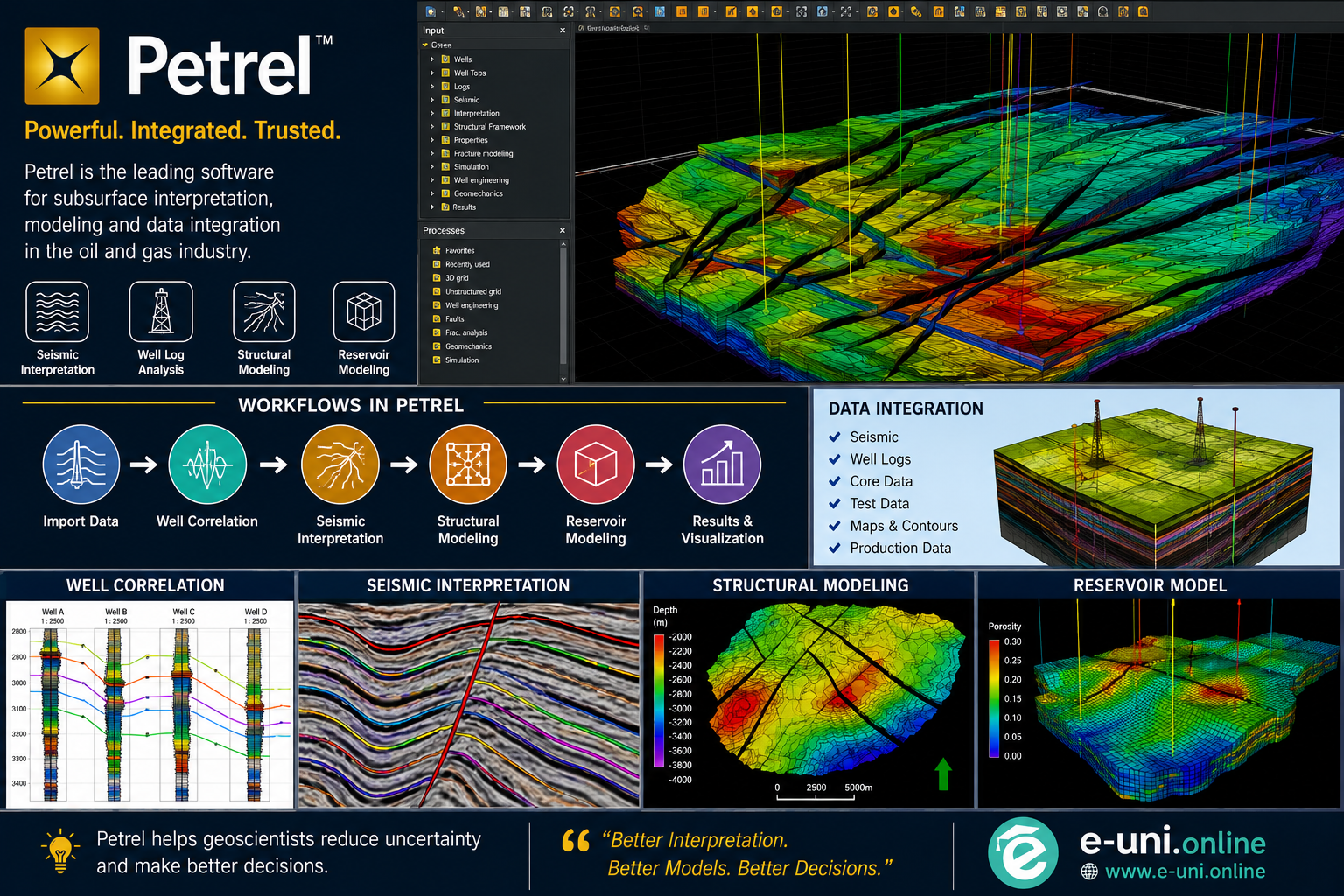
The first time I opened Petrel, I just stared at the screen wondering where to even begin.
There were folders everywhere, windows opening inside other windows, strange terminology, and dozens of processes I had never seen before. I remember importing a seismic file incorrectly and spending almost an entire afternoon trying to figure out why nothing was displaying properly.
At that moment, Petrel felt less like software and more like an aircraft cockpit.
But after working on real exploration projects, interpreting wells, building maps, tying seismic, and handling structural workflows, I realized something important:
Petrel becomes incredibly powerful once you understand the workflow behind it.
Most beginners struggle not because the software is impossible, but because they try learning random buttons instead of understanding the bigger picture.
If you’re new to Petrel or planning to learn it for oil & gas exploration, reservoir studies, or geomodeling, this article will save you from many of the mistakes I made early on.
“Petrel is not just software – it’s where geology, seismic, and interpretation come together to reveal the story beneath the surface”
What Is Petrel Actually Used For?


Petrel is one of the most widely used software platforms in the oil and gas industry for subsurface interpretation and modeling.
Geologists, geophysicists, petrophysicists, and reservoir engineers use it to work with:
- seismic data
- well logs
- geological maps
- structural models
- reservoir properties
- simulation models
Instead of using multiple disconnected software packages, Petrel allows teams to work in one integrated environment.
That integration is what makes it so valuable in real projects.
For example, while working on exploration studies, I’ve used Petrel for:
- seismic interpretation
- horizon picking
- fault mapping
- well correlation
- depth conversion
- structural framework building
- prospect evaluation
And honestly, one of the biggest advantages is visualization.
Seeing wells, seismic, horizons, and faults together in 3D changes how you understand the subsurface.
The Biggest Beginner Mistake in Petrel
Most people jump straight into modeling.
That’s a mistake.
I’ve seen beginners trying to create reservoir models before they even understand:
- project setup
- coordinate systems
- data QC
- well tops
- seismic quality
- structural consistency
Petrel is workflow-based.
If your early steps are wrong, the entire project becomes messy later.
A wrong coordinate system alone can completely destroy your interpretation.
That’s why experienced interpreters spend a lot of time on:
- data organization
- quality control
- proper loading
- checking units
- verifying well positions
It sounds boring initially, but it saves huge amounts of time later.
My Real Learning Started With Well Correlation
One of the first workflows that truly helped me understand geology inside Petrel was well correlation.
Before that, I mostly saw geology as static maps and log curves.
But once I started correlating wells section-by-section, things changed.
You begin noticing:
- sand continuity
- shale breaks
- reservoir pinch-outs
- thickness changes
- fault effects
- stratigraphic trends
That’s where Petrel starts feeling practical instead of overwhelming.
Simple Workflow I Recommend for Beginners
If you’re learning Petrel for the first time, follow this order:
1. Learn the Interface Properly
Don’t rush.
Understand:
- Input pane
- Project tree
- Display window
- Settings window
- Process pane
This alone reduces confusion massively.
2. Practice Data Import Again and Again
Learn how to import:
- well headers
- deviation surveys
- well logs
- checkshots
- seismic volumes
- horizons
- faults
Most real project problems actually happen during import and data handling.
3. Focus on Well Section Interpretation
This improves geological understanding quickly.
Learn:
- well tops
- marker picking
- correlation panels
- lithology trends
4. Move Toward Seismic Interpretation
Only after understanding wells properly.
Practice:
- horizon interpretation
- fault picking
- seismic navigation
- well-to-seismic tie
5. Learn Structural Framework Basics
This is where many beginners get lost.
Structural framework building requires:
- clean fault interpretation
- proper horizon relationships
- consistent data QC
Without good interpretation, framework creation becomes frustrating.
The Moment Petrel Finally “Clicked” for Me
For a long time, I used Petrel mechanically.
Click this.
Run that process.
Generate map.
Export result.
But during one exploration project, I had to integrate:
- seismic interpretation
- nearby well production
- reservoir presence
- structural closure
- regional trend analysis
That’s when I realized Petrel is not just software.
It’s a decision-making environment.
The software itself does not find hydrocarbons.
Your geological understanding does.
Petrel simply helps visualize and integrate information faster.
That mindset changed how I worked completely.
Petrel Skills That Are Actually Valuable in Industry
Many beginners think knowing “buttons” is enough.
Industry teams care more about workflow understanding.
The most valuable skills are usually:
Seismic Interpretation
Especially:
- fault interpretation
- horizon mapping
- structural understanding
Well Correlation
Strong geological correlation skills are highly respected.
Mapping
Good maps still matter heavily in exploration.
Data QC
Underrated skill.
People trust interpreters who catch errors early.
Integrated Interpretation
The ability to combine:
- geology
- geophysics
- petrophysics
- production data
…is what makes someone valuable.
Common Petrel Problems Beginners Face
“Everything Is Greyed Out”
This usually happens because:
- workflow dependency is incomplete
- object selection is wrong
- required processes are missing
- framework setup is incomplete
I struggled with this many times while learning structural modeling.
Usually the issue was not the software — it was the workflow sequence.
Slow Performance
Petrel can become heavy quickly.
Especially with:
- large seismic volumes
- multiple windows
- attribute cubes
- complex projects
A good workstation matters.
RAM and SSD performance make a huge difference.
Poor Seismic Display
Sometimes beginners think seismic quality is bad when actually:
- color scaling is wrong
- display settings are incorrect
- vertical exaggeration is misleading
Small display adjustments can improve interpretation dramatically.
What Helped Me Learn Faster
Honestly, random YouTube tutorials alone were not enough.
The biggest improvement came from:
- practicing real datasets
- repeating workflows
- making mistakes
- troubleshooting errors
- discussing interpretations with experienced colleagues
One thing I strongly recommend:
Do not just watch tutorials passively.
Actually open Petrel and repeat every step yourself.
Muscle memory matters a lot with interpretation software.
Best Way to Learn Petrel in 2026
If I had to restart today, I’d learn in this order:
Stage 1 — Fundamentals
- interface
- project setup
- data import
- coordinate systems
- basic visualization
Stage 2 — Geological Workflows
- well correlation
- tops interpretation
- mapping
- reservoir understanding
Stage 3 — Geophysical Workflows
- seismic interpretation
- fault interpretation
- well tie
- attribute basics
Stage 4 — Modeling
- structural framework
- pillar gridding
- facies modeling
- property modeling
Stage 5 — Integrated Projects
Combine everything into one workflow.
That’s where real understanding develops.
The Industry Reality Nobody Tells Beginners
Knowing Petrel alone does not guarantee a job.
This is important.
Petrel is a tool.
Companies hire people who can:
- interpret geology correctly
- reduce uncertainty
- identify drilling risks
- understand reservoirs
- integrate datasets
- communicate findings clearly
I’ve seen people with average software skills but excellent geological understanding outperform software experts.
Focus on subsurface thinking first.
Software becomes easier afterward.
Why Petrel Still Matters Despite AI Growth
A lot of people ask whether AI will replace interpretation software workflows.
From what I’ve seen, AI is becoming useful for:
- automation
- log prediction
- attribute analysis
- pattern recognition
- data handling
But geological interpretation still requires human reasoning.
Especially in exploration, uncertainty is everywhere.
Fault relationships, depositional interpretation, trap integrity, reservoir continuity — these decisions still rely heavily on expert understanding.
That’s why Petrel remains highly relevant.
The workflows may become smarter, but interpretation expertise still matters.
Final Thoughts From Real Project Experience
Learning Petrel can feel intimidating in the beginning.
Almost everyone struggles at first.
I certainly did.
But once workflows start connecting together, the software becomes far more intuitive and genuinely enjoyable to use.
One interpreted horizon starts connecting to fault trends.
Fault trends connect to structure.
Structure connects to reservoir distribution.
Reservoir distribution connects to prospectivity.
That’s when subsurface interpretation becomes exciting.
And honestly, that feeling of finally understanding the geology beneath the surface is one of the reasons many professionals stay passionate about this industry for years.
Tags: